


The Spiritual Journey – Verbascum Thapsus (The Great Mullein)
Updated: Apr 8
by Mirjana Zivanov

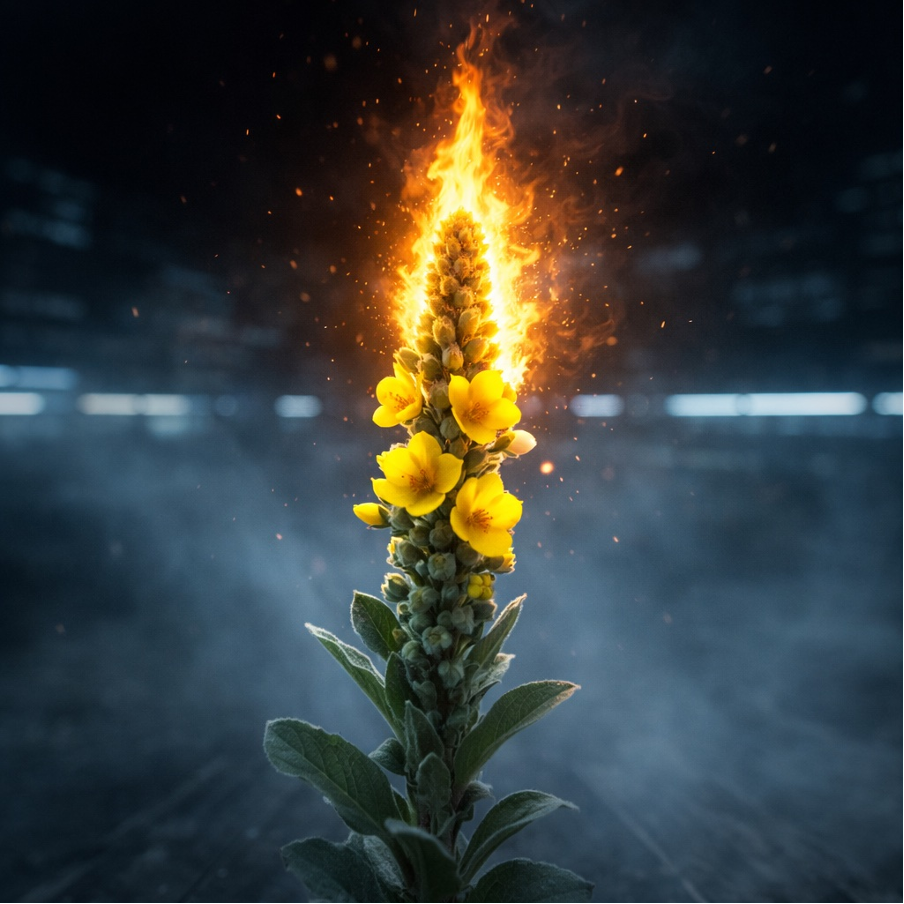
This is my remedy portrait of Verbascum Thapsus — Code ACCEPTED – NOT ACCEPTED.
The person lives in a quiet yet profound split between the need to be seen, recognized, and accepted — and the experience of being rejected, overlooked, or unheard.
One part of the being stands open, ready to appear in the world, to speak, to be present.
The other withdraws into shadow, becomes silent, fades — because it is not accepted.
When acceptance is present, the voice returns.
When acceptance is absent, the being retreats into silence.
Between ACCEPTED and NOT ACCEPTED arises the essential question:
Am I allowed to exist as I am?

Verbascum as Hermes and Saint John
In mythology and folk belief, mullein (Verbascum) is associated with protection during transitions between the world of the living and Hades, and with the god Hermes, the only god who moves freely between Olympus, Earth, and the Underworld. His path through Hades is illuminated by the caduceus — a torch made of mullein. Verbascum is also linked to the goddess Hecate, ruler of Hades, again in the sense that mullein is the only plant that illuminates the Underworld.
On funerary Apulian vases from the 4th century BCE, floral motifs have frequently been depicted that were recently identified as Verbascum Sinuatum, symbolizing regeneration and the protection of the soul on its journey into the afterlife.
The Romans called it Candela Regia — the Royal Candle, because when soaked in tallow or resin, its stalk burned slowly and for a long time. It was therefore used to illuminate temples and funerary processions, as it spiritually lights the path and protects the deceased from evil forces on the journey to Hades.
Saint John the Baptist as the Bearer of Light
In Christian iconography and tradition, Saint John the Baptist assumes the role of the ancient “bearers of light,” and mullein becomes his key botanical symbol.
Saint John as the “Lampstand”
Just as Hermes announced the gods, John the Baptist announces Christ. In the Gospel of John (5:35), Christ says of him:“He was a burning and shining lamp.”For this reason, folk tradition called mullein — this natural torch — “the Lampstand of Saint John.”
The Feast of Saint John (Ivanjdan) and the “Fire Plant”
The symbolism is strongest during the summer solstice (Ivanjdan, June 24 / July 7), when mullein begins to bloom.
· St. John’s fires: In many European folk traditions, mullein stalks were burned in solstice bonfires. It was believed that the smoke of this plant blessed livestock and fields, similar to ancient purification rituals.
In Renaissance paintings, mullein sometimes appears in the background of depictions of John the Baptist in the wilderness. Its upright growth symbolizes:
· Preaching: A voice crying out in the wilderness.
· Asceticism: The ability to survive in harsh, rocky conditions, just as John lived in the desert.
Protection from Lightning
Since John the Baptist is believed in folk tradition to protect from lightning by calming the wrath of Saint Elijah, mullein was hung on houses as a lightning charm. Its tall stalk resembles lightning “frozen” into a plant. It was also used in “Thunder Candles” (Candlemas), where the wicks of candles blessed in church against lightning were originally made from the “wool” of mullein leaves.
This theme of Hermes and later Saint John is of great importance.
Hermes as the One Who Calms Zeus
In classical mythology, Hermes (Mercury) rarely stops Zeus’s hand physically, but he plays a crucial role as a diplomat and mediator who, through intellect and speech, calms the rage of the supreme god and prevents catastrophe.
He does not use force, but cunning and persuasion — a direct parallel to how mullein (as his plant) is used in magic: not to fight lightning, but to appease or redirect it.
Examples of how Hermes calms Zeus include:
· Diplomacy through words: Hermes is the only one who can speak truth to Zeus without provoking his anger. He acts as a buffer between Zeus’s fury and mortals.
· The Myth of the Lyre: When Hermes stole Apollo’s cattle, Zeus was ready to punish him severely. Hermes then invented the lyre, and his music so enchanted Apollo (and thereby calmed Zeus) that anger was transformed into admiration — a classic example of how Hermes’s “product” (art/intellect) transforms destructive energy.
· Mediator in conflicts: During the Trojan War and internal conflicts on Olympus, Hermes often carried messages that eased tensions before Zeus reached for the thunderbolt.
The Parallel with Saint John and Saint Elijah
This relationship is almost identically mirrored in Christian folklore:
· Saint Elijah (Zeus) is the one who “wants to strike with lightning” because the people are sinful.
· Saint John (Hermes) is the one who pleads or delays the strike. In many Balkan folk songs, Saint John or the Virgin Mary calms Saint Elijah, telling him that it is not yet time for punishment.
Hermes does not tame Zeus by force, but by restoring reason. Thus, mullein is the plant of reason and enlightenment(Hermes), standing opposite raw power (Zeus). It is a “lightning rod” not because it is stronger than lightning, but because it is its spiritual sister, speaking the same language of fire.
For this reason, mullein is sometimes associated with the goddess Athena (wisdom), but the parallel with Hermes is far stronger, since the primary theme of this plant is protection and illumination during transitions between worlds.
Modern Science and Verbascoside
Interestingly, modern research indexed on PubMed shows that verbascoside, an active compound of mullein, acts as a neuroprotector.
· Calming the “electrical storm” in the brain: On a molecular level, these compounds reduce excessive neuronal excitation — what folk tradition once called “calming Elijah’s thunder.”
Pliny the Elder and the Royal Candle
In Ancient Rome, Pliny the Elder, in his Naturalis Historia, laid the foundation for the use of both names.In Book XXV, Chapter 73, he directly links the botanical name to its use:
“Verbascum… Latini candelam regiam vocant.”(“Verbascum… which the Latins call the Royal Candle.”)
Pliny recorded this because he was fascinated by how plants were used in everyday life. He explains that the name comes from the fact that the dried stalk could be used as a torch (funale).
In medieval manuscripts based on Roman tradition — such as those preserved in the Botanical Garden of Padua — this passage of Pliny is frequently cited to explain the connection between the plant and light.
Another important source is Pseudo-Apuleius (Herbarium, 4th century), who also calls the plant Verbascum and gives instructions for its use, confirming the epithet “Royal Candle” because of its power to “drive away the fears of the night”and demons.
Pliny’s Medical Recipes
Pliny the Elder, in Naturalis Historia Book XXV, Chapter 73, gives a detailed description of mullein’s medicinal use, focusing on respiratory conditions.
Key remedies include:
· Chronic cough (tussis): Pliny recommends boiling the root of mullein in water. According to records preserved in the Perseus Digital Library, the decoction was drunk to relieve inflammation of the throat and lungs.
· Wine therapy: He often advised soaking the root in wine to extract its healing properties, considering this an effective remedy for phthisis (an ancient term for tuberculosis or lung wasting).
· Honey mixtures: In Roman medicine, mullein was frequently combined with honey to ease expectoration — a practice preserved in modern folk syrups.
· External use: Pliny also notes that the leaves, when boiled in vinegar, were used to relieve joint pain and heal wounds.
Historical sources on Roman military medicine indicate that Roman soldiers used these remedies during campaigns to treat respiratory infections caused by dampness and cold.
Medieval Monastic Medicine
In the Middle Ages, mullein was indispensable in monastic gardens (hortus conclusus). Monks, who preserved ancient knowledge, adapted Pliny’s recipes:
· Syrup for “shortness of breath”: Mullein flowers were layered in jars with sugar or honey and left in the sun. The resulting syrup was used for asthma, as documented in the writings of Hildegard von Bingen, who described the plant as “woolly” and considered it essential for the “warmth of the lungs.”
· Smoke therapy: Instead of drinking decoctions, dried leaves were burned and the smoke inhaled (similar to modern inhalations) to calm spasms, believing that the “fire of the plant” expelled dampness from the body.
Modern Phytotherapy
Modern science confirms that Pliny was correct. The main active compounds in Verbascum species are:
1. Saponins: Natural detergents that break up thick mucus in the lungs, facilitating expectoration.
2. Mucilages: Complex sugars in the leaves that form a protective layer over inflamed throat mucosa, reducing cough irritation.
3. Verbascoside: According to studies published on ScienceDirect, this glycoside has strong anti-inflammatory and antibacterial properties, explaining the plant’s effectiveness in treating infections.
In modern phytotherapy and holistic systems such as Bach flower remedies or similar approaches, mullein is used for people who feel “stuck” or “in the dark” regarding their life purpose.
The Symbolism of Verbascum
Verbascum is a symbol of balance. It is:
· Strong enough to stand upright in the wind (integrity),
· Gentle enough not to harm (empathy),
· Luminous enough to show the way (vision).
The Royal Candle and the Stone
In 2024, I was staying in Windsor because of a lecture in London. Already then, I felt a call — quiet, yet persistent.One day, I went to Kingston, just briefly, without a plan. I stood there and spoke, almost like a vow:“Next year — I will be here.”
At that time, I did not know why Kingston. But the body knew before the mind.
Kingston is a place of coronation. A place where one does not become a king by force, but by recognition. Where the stone remembers the silencein which the crown is placed.
It is precisely in Kingston and its immediate surroundings, in the royal parks and green expanses along the Thames, that deer walk freely.Without fences. Without fear. Like living memories of the royal silence of nature. Their antlers carry the shape of a crownthat does not demand attention — but dignity.
Verbascum — mullein, the Royal Candle — stands upright like a pillar of light. It does not seek applause, it does not bend to the wind. Its essence is dignity that endures. The PRESERVATION of life through silence.
The deer — the quiet bearer of nature’s crown — walks nobly, without the need to dominate. Its crown is renewed each year, as a reminder that true kingship lies in renewal, not in conquest.
And that is why Kingston. Because Verbascum does not seek a stage, but a place where one stands. Because the Deer does not rule, but radiates. Because Spiritual Quality is not a title, but a state after Integration — when nothing needs to be proven anymore.
This year, I return to Kingston to present a bookand a testimony of Spiritual Quality. Not as an author coming to claim recognition, but as a witness to a royal and noble quality of existence that is recognized in silence.
Spiritual Quality is not a crown that I wear. It is a crown that the Universeplaces through me.
In Kingston, the Coronation Stone is still preserved — upon it kings were crowned, because in that ancient orderit was not the sword that was decisive, but the stone that receives, bears, and confirms dignity. And then the light does not go out — it simply remains standing.

Verbascum person has a feeling of being different, lonely, standing taller than others, with a deep inner life, intense mental processes, and a constant search for meaning.
Patient:“Yes, that’s true! During my teenage years, in high school, I tried to fit in with many different groups of people (Verb)! My best friend noticed that about me. She says that I change my opinions. But it’s not that I change my opinions — rather, I adapted to certain groups of people in order to somehow find my place (Verb). But that didn’t happen, and so on… So it is true that I was seeking to be ACCEPTED (Verb) by other people. Of course, most people seek some form of social approval. But I feel it is harder for me to obtain it, because I think differently (Verb) from almost everyone I know.”
In addition to not being ACCEPTED by others (Verb), she eventually does not ACCEPT herself (Verb) either and enters a phase of self-destruction…
Dr:“You changed social circles, you tried — but in the end, it always resulted in you feeling NOT ACCEPTED (Verb)?”(Matrix potentiation)
Patient:“Yes! And maybe it’s also important to mention that I went through a period of self-destruction (Verb). I spoke with a psychologist — maybe it comes from that inner feeling of NON-ACCEPTANCE (Verb) and insufficient self-worth (Verb). In high school, I was part of a group of friends (Verb, Phos), where my first boyfriend was. Then they started using drugs. That was a very traumatic period of my life (Verb). After that, when everything was over, and when I moved to Germany for my studies, for four or six months I dreamed about those events every night — because I felt that it wasn’t me, that it was a great EVIL (Bry), very BAD (Bry) things that I entered into because of people who were close and dear to me.”
Dr:“In order to be ACCEPTED (Verb) by the group?!”
Patient:“Yes! These were people I went to school with, people I felt understood me better than anyone else I was in contact with at that time. As if they were similar to me — and for the sake of that closeness, I stayed in it, even though I knew it was not SOMETHING (Phos)… that it wasn’t me! And how BAD (Bry) it was for my health.”
Dr:“So that you could remain part of that group.”
Patient:“Yes!”
Dr:“Do you remember any other situation when you felt NOT ACCEPTED (Verb)?”
Patient:“For example, we were at a friend’s house, talking about social media and what kind of photos people have, and she said about me: ‘Look how she looks like a celebrity on Instagram — and look what she looks like in real life!’”
Dr:“Really?”
Patient:“Yes! And this was a friend I had been close to for years…”
Dr:“And how did you feel then?”
Patient:“NOT ACCEPTED (Verb), and as if it was a very strong blow (Ferr-p), unexpected! (Verb, Stram)”
Dr:“Do you remember any other similar events?”
Patient:“I can’t recall any right now, but human behavior (Verb) and people’s decisions (Verb) often shock me (Verb). And… I feel NOT ACCEPTED (Verb) by my father.”
Dr:“What is it like to be alone in Germany?”
Patient:“It was a decision I wanted, and I am satisfied. I would never return. So I think it is good that I am there, and that I am still with him — but when it comes to ACCEPTANCE (Verb) and finding the right circle of people…”
Patient:“Yes. Maybe it’s important to tell you that I underwent regression therapy. In the past life I saw, the main theme was — again (Cann-i) — my father (Verb). I saw myself sitting at a table with a stepfather (Verb). My mother was there, she looked different, and she had a small baby — my sister. The father (Verb) was eating and did not give food to my mother or the baby; they were hungry, and I watched him eat selfishly (Verb), while there was nothing for us. So the themes repeat themselves!”
Dr:“You see — in that story as well, you were NOT ACCEPTED (Verb) by him!”
Patient:“Yes! Only in that life I felt that the father had died, and that the stepfather (Verb) was the selfish one. And maybe that’s why in this life I feel as if my father is not really my father — as if he is forced to play the role of a father (Verb).”
Dr:“The stepfather is a symbol of NON-ACCEPTANCE (Verb), because you are not his child.”
Patient:“Yes!”
Dr:“A typical situation for your Code: ACCEPTED – NOT ACCEPTED.”
Patient:“Yes!”
Transgenerational Example of the Verbascum Code (ACCEPTED – NOT ACCEPTED)
Another patient is a man — my grandfather — whose entire life was marked by a deep sense of NON-ACCEPTANCE, wherever he went. After his father and three brothers were killed before his eyes during the revolution in Imperial Russia, he was forced to flee by ship with a group of survivors. After two weeks at sea, the ship arrived at a Greek island where there was neither water nor food. No surrounding country wanted to ACCEPT them.
Under those conditions, almost everyone fell ill with typhus, which most did not survive. My grandfather remembered thirst, high fever, and receiving water by the spoon while burning with fever — for the rest of his life. Even then, Greece did not truly ACCEPT them. The only country that opened its doors and ACCEPTED them was Serbia.
He was first placed in the Gornjak Monastery, and later in Novi Sad, where Russian refugees were given small plots of land so they could build houses and begin new lives. He married a woman who was an orphan — her mother had died during childbirth in Bosnia — and who also came to Novi Sad because one family had ACCEPTED her.
However, the feeling of NON-ACCEPTANCE repeated itself through historical changes: as governments changed, the family was constantly under suspicion — labeled as “Russian spies.” Their houses were searched; they were interrogated and followed. The communists questioned them, and during the Hungarian occupation, my grandfather was even taken to be thrown under the ice of the Danube. He survived only because executions were stopped about ten people before him. Ice and snow — symbolism deeply belonging to Verbascum — literally saved his life.
Despite everything, he dreamed all his life of returning to Russia. That dream never came true. He died on Christmas Eve, in January, during a winter with nearly two meters of snow. At the funeral, it was barely possible to walk — everywhere there was silence, peace, the pallor of snow, and deep stillness. The atmosphere was almost divine — precisely that silence and uprightness that Verbascum carries in its essence.
My grandfather had blue eyes, gray hair white as snow, and he remained upright like a candle (Verb) throughout his life, regardless of all the horrors he endured. He had one daughter — my mother — whose Simillimum was Sulphur. The two of them were connected through struggle: his inner, quiet struggle was transferred to her as an external, explosive struggle, fully expressed.
This example clearly shows how the Code: ACCEPTED – NOT ACCEPTED can be transmitted transgenerationally, changing form while retaining the same deep matrix — until it is recognized and integrated.
Theoretical Note: Simillimum and the Resolution of the Family Line
Simillimum does not act only on the individual’s symptoms, but on the deep matrix in which both the personal and the family Code are inscribed. When the Code is recognized and integrated in the consciousness of one person, the transgenerational repetition of the same pattern is interrupted. What manifested in previous generations as external fate (persecution, rejection, exile) appears in the next generation as an internal experience (not belonging, inner fragmentation, the search for acceptance), and is then, through Simillimum, resolved for the first time at the level of consciousness.
Thus, the lineage is not “healed backward,” but released forward — future generations no longer have to carry the same Code as destiny, but as an integrated experience.
Through the integration of the Code via Simillimum, what was destiny for generations ceases to repeat itself and becomes a quiet, liberated experience of consciousness.

Themes of the Remedy
1. Interest in Spiritual matters and philosophy
They come with clear motivation — they are not seeking only relief of symptoms, but spiritual development and the integration of polarities, which in Verbascum often goes together with the feeling that “the material world is slow,” while the inner vertical axis already sees wider and farther.
They are exceptionally curious; they love philosophy and spiritual topics. Even a very young Verbascum person will show strong spiritual curiosity and introspectiveness. They love to discover truths and are able to devote themselves to it completely. They are not interested in the superficiality of everyday life — they cannot even imagine themselves living such a life. They are usually spiritually very mature for their age. A 22-year-old patient says:
Patient: “And when I imagine myself, I don’t see myself in any specific profession (Verb). I don’t know how to choose what I want to do, because I feel as if my goal is something bigger — a kind of general learning about different things in the world, spiritual growth (Verb)!”
Dr: “Many people look into the future, but you truly see it — a strong, open vertical axis (Verb). All of this feels essentially miserable to you (Verb), to occupy yourself with something…”
Patient: “Yes, yes!”She is laughing now… because I touched the theme.
Dr: “You deserve to engage with more spiritual things, because you are able to carry that.”Patient: “That’s exactly how I feel — as if I need SOMETHING (Phos) that would truly interest me, to discover my path! (Verb) Because I know what the lives of average people look like (Verb) — what they do, how they live — and I wouldn’t want to choose SOMETHING (Phos) just because it comes easily to me, or because someone said I should do it, or because I would have a good salary… I feel I should do SOMETHING (Phos) significant (Verb)! Helping other people (Verb, Lotus), or contributing to society in some way (Verb).”
Dr: “That is a spiritual calling, because you are a spiritually awakened person. That is very rare — that’s why you speak like this. You simply cannot do ordinary worldly things; that is not for you — spiritual callings are. Soon after our therapy, what your calling or task will be will appear. At that age we also had inner turmoil — we could not engage in ordinary professions. We were searching for something more, something deeper (Verb). It’s excellent that you came to us now, so that from here on it opens easily for you, and you can orient yourself quickly.”
Patient: “Yes, I really love that I came.”
Patient: “Maybe I could also add something that might help you understand my personality — that I am a very introspective (Verb) and spiritual (Verb) person. And that is also what the psychologist I work with says, because he has experience with people my age. The fact is that I think A LOT (Alu) about myself and about the world (Verb), about life (Verb), about meaning (Verb); I ask philosophical questions (Verb). I think it is also IMPORTANT (Cann-i) that the reason I became interested in coming to you is because such themes interest me deeply (Verb).”
She thinks deeply for her age…
Patient: “For me it makes no sense (Verb) for someone to strive for physical healing without also thinking about healing their emotions, because the two are connected.”
We also have the case of “Grandfather the Russian,” who escaped death in Imperial Russia — and it is not by chance that he first ended up in the Gornjak Monastery (Verb). He lived there for a time, before they redirected them further.
2. The theme of Rejection and lack of love
They feel rejected in society because they are different and more mature than their peers. They stand “higher” than others — and the moment someone is different, society tends to label them and in some way reject them, eliminate them so they do not disturb the average.
Patient: ““My father criticized me a lot. I received no love and attention (Verb) from him — only criticism, emotional distancing, and rejection (Verb).”
Patient: “My father is a person with zero friends (Verb), and he rejected (Verb) everyone who showed interest in socializing with him.”“And the way he rejected it (Verb) was like: ‘You’re talking nonsense, it’s not like that…’ But the truth is, I felt UNLOVED (Phos-ac) by him.”
Our other patient, “Grandfather the Russian,” always felt rejected by his homeland. Despite all attempts to connect with people, in the end he was still alone in old age (Verb).
The common thread of these testimonies is a deep sense of REJECTION — but also a subtle, often unconscious tendency to reject others when there is no understanding, recognition, or emotional validation. In Verbascum, the wound formed through rejection does not remain passive — it turns into distance, withdrawal, or rejecting others, as an attempt to protect oneself from the renewed pain of being unseen and not accepted.
3. The theme of Autumn
A Verbascum person may appear cold, but in essence they are calm and mature. They love settling, not awakening. They love the end and ripening, not the beginning and growing up. The patient even states that her favorite season is autumn, when everything becomes quiet.
Dr: “Do you prefer summer or winter?”
Patient: “Autumn (Verb)!”
Dr: “And why autumn? Explain a little…”
Patient: “I like that EVERYTHING (Staph) CALMS DOWN (Arg-n). I don’t want to say it dies, but I like that everything dies (Verb). I associate autumn with an idyllic atmosphere (Verb). Dry leaves (Verb). I was born then! I love that gloomy ambience (Verb, Caust) and the smell of burning firewood (Verb).”
Dr: “You are a rare person — most usually say winter or summer — but you see, it is not accidental, because the plant from which we will prepare your remedy keeps its flower all the way into autumn. It dries, but it looks as if it were still fresh.”
4. The theme of loneliness and society
They love company; they miss people — but only those who truly understand them. Because of this need for belonging, they try to fit in, and sometimes endure for too long and too much, just to be ACCEPTED (Verb).
Dr: “How did you feel in those moments?”
Patient: “Maybe lonely (Verb), different (Verb). I still feel that in certain situations even today — not that I lack people around me, but I lack people who truly understand me (Verb) and think (Verb) similarly to me. People who understand my views (Verb).”
Dr: “Give us another example of when you felt lonely.”
Patient: “I don’t know — it’s not an intense feeling, but loneliness follows me somewhere deep in my soul my whole life (Verb).”
Dr: “You are different from others (Verb). As if you stand alone (Verb), then there is a lot of space in between, and only then someone similar to you appears? (Verb)” (Matrix potentiation)
Patient: “Yes — that’s exactly how I feel.”She emphasizes…“When I speak about that loneliness (Verb), very few people can reach that core, that truth of who I am — and with the others I just socialize, and they know only one PART (Arn) of me, which is somewhat normal.”
5. The theme of low self-worth
“I have a feeling of low self-worth (Verb). As if I never learned to love myself — and I believe that is because of his rejection (Verb), the emotional distancing (Verb) when I was little.”
In Verbascum, low self-worth does not arise from a real lack, but from an early experience of emotional rejection and distance — therefore one’s value is never internalized. The being does not learn to love itself, because it was not seen, confirmed, or accepted — so the sense of personal worth is constantly sought outside, or withdraws into silence.
6. The theme of Moving / Relocation
In Verbascum, relocation is not only a physical change of place — it deeply activates the inner feeling of being uprooted and separated. Every change of place reopens the old theme of rejection and loss of belonging; the struggle (Sulph) intensifies, and the being returns to searching for safety and stability that was never permanently established.
Patient: ““My whole (Arn) life there has been that struggle (Sulph) inside me, and I think I am currently in a stressful situation because I moved away (Verb).”Grandfather the Russian moved many times before he stabilized.
7. The theme of looking into the future
In Verbascum, the gaze is constantly oriented toward the future, because the present does not feel like a safe place for action. The being already sees itself “there,” in a higher, abstract world where meaning is already fulfilled, while concrete steps in material reality remain ungrasped. This discrepancy between inner vision and outer action creates insecurity, a feeling of being lost and stuck — so energy is spent on planning and fantasizing rather than present action.
“…and now in my third year of university I am NOT SURE (Formica rufa, Sil, Verb) what I want to do in life and what choice I want to make (Verb). I focus intensely on the future (Verb), I excessively make plans for the next 20 years (Verb), instead of acting in the moment and focusing (Verb) on what is in front of me.”
Dr: “You look into the future (Verb)?” (Matrix potentiation)
Patient: “Too much! Like excessive fantasizing about what could be — and I do NOTHING (Staph) in the present for that outcome to actually happen.”
Dr: “You don’t look at the steps — you already see yourself there. Because you are advanced; in that higher world you have already done everything — only the material world is lagging behind.”
Patient: “You described it very well — that is exactly how I feel. And when I imagine myself, I don’t see myself in any specific profession (Verb). I don’t know how to choose what I want to do, because I feel as if my goal is something bigger.”“And I know many people my age feel somewhat LOST (Gala), but for me this thinking about the future sabotages me from acting in the present (Verb).”
8. The theme of Emotional fragility
In Verbascum, emotional fragility directly reflects on the physical level through frequent but mild illnesses, especially colds, as an expression of reduced inner resilience. When the being lacks emotional support and a sense of safety, vital energy drops easily; but in the presence of closeness, acceptance, and a stable relationship, the inner structure strengthens and physical sensitivity recedes.
“On the emotional level I was very fragile (Verb, Phos), and because of that I often got sick — but it would just be colds (Verb). It passes in 3–4 days, but it happened very often. But since I now live with that boyfriend, it no longer happens.”
9. The theme of Perfectionism
In Verbascum, perfectionism does not arise from a healthy striving for quality, but from the inability to accept anything that is not absolutely perfect — because the “in-between” is experienced as personal failure. Strictness toward oneself becomes a defense against rejection and inner “wrongness”; any result that is not maximal is felt as proof that “something is not right.” Instead of flexible growth, the being moves between extremes — perfect or nothing — maintaining constant tension, dissatisfaction with oneself, and a deep feeling of inner inadequacy.
Dr: “Describe that PERFECTIONISM (Cac) to us.”
Patient: “For example, I finished high school with a 5.00 average. Although I think it’s easier in our system to have PERFECT (Carc) grades than in other systems. I’m used to doing things either PERFECTLY (Carc, Verb) and to the maximum — or not putting in any effort at all (Verb, Lotus)! And I cannot accept some result in between (Verb, Lotus)! It was hard for me to ACCEPT (Verb) that I cannot do everything maximally well (Verb).”
Patient: ““My mother told me that when I was little, for example I would draw something and show her the drawing, she would say it’s beautiful (Carc) — but I would tear it up (Verb) because I REALLY DON’T LIKE it (Phos-ac), because I think it is NOT PERFECT (Carc), that I could have done it better. Very great strictness toward myself (Verb)! Lately, I have the feeling — I don’t know if I can call it PERFECTIONISM (Carc).”
“I have a feeling that something is not right (Carc).”
10. The theme of endings — death
In Verbascum, the theme of death has two faces: on one side there is a deep fear of dying, and on the other a strong attraction to quieting, silence, and the end of the cycle. The being is often a witness to endings — not as a participant, but as an observer — so death is experienced not only as loss, but also as a state of peace, the extinguishing of noise, and a return to silence. Early testimonies of violence and dying leave a permanent imprint, so death simultaneously frightens and calms: it awakens horror, yet also brings an idyllic sense of stillness — especially through images of autumn, dry leaves, and a fading fire.
On one side she fears the theme of dying, and on the other she likes when everything in nature becomes quiet, dies, and the cycle ends.
Patient: “That scene and thinking about death in general frightened me a lot (Verb).”Patient: “I like that EVERYTHING (Staph) CALMS DOWN (Arg-n). I don’t want (Phos-ac) to say it dies, but I like that everything dies (Verb). I associate autumn with an idyllic atmosphere (Verb). Dry leaves (Verb). I was born then! I love that gloomy ambience (Verb, Caust) and the smell of burning firewood (Verb).”
They often witness the dying of other beings. Grandfather the Russian witnessed horrific violence and the murder of his father and three brothers. He was only 16 years old then and was a witness to that event (Verb). Later he again witnessed and watched (Verb) how the Hungarian authorities, on the Danube, threw people under the ice.
11. The theme of Truth
Wherever it enters, a lie cannot survive. In the presence of Verbascum, it is exposed like a torch in the darkness — not because it attacks, but because it spreads light. Everything that was hidden, distorted, or unspoken becomes visible, because the truth of this remedy does not seek conflict — it illuminates. And in that light, the lie withdraws on its own.

Personal Experience with Verbascum
During the summer, I was painting and renovating my house. Through a friend, a married couple came — they work together: he paints the walls, she paints woodwork. From the very first meeting, the woman struck me as a clear Verbascum person. Almost immediately we felt closeness and recognition, as if our souls had known each other before.
The work lasted several days, so we talked a lot — about life, experiences, everything and anything. One day during the renovation, the woman who usually cleans the house also arrived. Confusion arose because she wanted to wash the windows, but the workers were still in the middle of the process and told her it couldn’t be done that day. The cleaner reacted strongly and became furious.
In that moment, an old wound opened in me — a memory of my cat who had disappeared years ago. She had been the last person who was with him in the house at that time. The Verbascum woman looked at me and asked what was wrong, because she felt that I had become disturbed. I opened up to her and told her how my cat had disappeared then, and that this woman had been the last one with him.
Without hesitation, quietly and completely calmly, the Verbascum woman said to me:“She took him.”
The cleaner did not hear it.But a few moments later, suddenly and loudly, she herself said:“I would put all these cats into a sack and take them away!”
In that moment I literally froze.The truth surfaced by itself.
When the cat had disappeared, we checked the cameras and saw that she carried a black sack out of the house — but we never had proof that the cat was inside it. Now there was no need for proof. The sentence said everything.
The cleaner began to tremble with rage — not because she was accused, but because the truth had come into the light.
This is one of the most striking examples from my experience showing how the presence of Verbascum illuminates truth:not through confrontation,not through accusation,but through its very existence.

Pre-codes
Thuja occidentalis with the Code: PLEASANT – UNPLEASANT
Dr: “Do you like milk?”
Patient: “I do, but it doesn’t AGREE with me (Thuj) — I get bloated.”
Dr: “Maybe because most milk is industrial, full of antibiotics. Would it be different if you drank it straight from a cow?”
Patient: “Possibly — I’ve never tried. And I really do love milk. (Verb, Phos)”
Dr: “What is it like to be in Germany without your parents?”“On the one hand it FEELS GOOD (Thuj), because I feel I can change more easily and progress (Verb), because society in general seems more advanced than ours. In that sense it FEELS GOOD (Thuj) that people are more educated (Verb) and judge each other less (Verb).”
Dr: “What was the smell of the urine like when you felt burning during urination?”
Patient: “Oh, I don’t know — somehow UNPLEASANT (Thuj). I generally felt pain, but it was stronger in the middle of urination and after urination, until it CALMED DOWN (Arg-n). I felt that I didn’t know how to say ‘No!’ I didn’t know how to fight for myself — to say: ‘Hey, that does NOT AGREE with me (Thuj)!’”
Grandfather the Russian could not tolerate either the smell or the taste of garlic (Verb, Thuj).
Formica rufa with the Code: SAFE – UNSAFE
Patient: “I feel as if I’m holding on tightly to my body, to this reality. Recently I’ve had episodes when returning to Serbia from Germany. We were driving back — my mother and I saw a traffic accident. Everyone survived, the whole family got out of the car, and I started crying intensely! That scene, and thinking about death in general, frightened me a lot (Formica rufa, Verb).”
“I focused a lot on my father, trying to see what was happening — why he was withdrawing (Verb), why he behaved that way. In him I saw a kind of INSECURITY (Formica rufa, Sil), dissatisfaction (Phos-ac). But he lost his brother in an explosion, in a factory.”
“I live in Germany, I was finishing university, but now I’m again in my third year because I changed (Verb, Phos) my program — I didn’t like my first choice — and now in the third year I am NOT SURE (Formica rufa, Sil, Verb) what I want to do in life and what choice I want to make (Verb)!”
“I have a BAD (Bry) relationship with my father, and from that come various INSECURITIES (Formica rufa, Sil, Phos, Verb) in my life.”
Patient: “I felt UNSAFE (Formica rufa, Sil) and misunderstood (Verb). And now I feel SAFER (Formica rufa, Sil), although I am trying to reach the point where I feel SAFE (Formica rufa, Sil) with myself — where I am enough for myself.”
Grandfather the Russian always felt UNSAFE (Formica rufa, Sil), because every new regime would interrogate him and suspect him.
Similar remedies
Phosphorus with the Code: SOMETHING – NOTHING
“It’s just that SOMETHING (Phos) has to interest me strongly for me to dedicate myself to it.”
Unlike Phosphorus, which can sometimes be a bit superficial, Verbascum is the opposite…
Dr: “You have much deeper thoughts (Verb), so it’s harder to find company when you stand out (Verb) so much?” (Matrix fishing)
Patient: “I like what you said: ‘deeper thoughts.’ Sometimes I am disgusted or irritated by the superficiality of people (Phos) around me. I feel I miss depth — depth in human emotions and relationships, and in intellect (Verb). I think that’s what I’m looking for: a deeper connection with someone (Verb).”
Grandfather the Russian survived typhus in harsh circumstances — on an island without water, food, or family — at only 16 years of age. We know Phosphorus is a major epidemic remedy for typhus. Clearly, Verbascum is also a major remedy for typhus, since he showed strong immunity compared to others.
Kalium phosphoricum with the Code: INDIFFERENCE – RAGE
They can resemble each other, but Verbascum is more sensitive, more fragile, gentler — and in it there is a steady coldness of pure snow: peace, silence. A pleasant peace — reconciliation with everything.In Kalium phosphoricum we find the same coldness and snow-like purity, but only on one side. On the other side there is fire and strong anger. Deep integration has not yet occurred.
Symbolically, it is striking that the Verbascum patient said she read our entire book, while the Kalium phosphoricum patient who came after her said she read only half of the book — she reached the middle. A perfect description of their stage of maturation.
Both remedies share the theme of exhaustion.
Dr: “How do you feel after talking with him?”
Patient: “Exhausted (Verb, Kali-p), as if he drained all my life energy (Verb, Kali-p).”
The image of Verbascum is a meadow covered with snow, where peace, harmony, and silence reign.The image of Kalium phosphoricum would be a snow avalanche sliding off a roof during sudden melting.
Arsenicum album with the Code: BURDENED – RELIEVED
“Then I started to WORRY (Ars, Verb) about my physical appearance (Verb).”“Thoughts stay in my head for weeks and months (Verb, Ars).”“A feeling that something is hidden (Ars, Verb). That someone is lying to me (Ars, Verb), that maybe I have a health problem (Ars, Verb).”
Grandfather the Russian took part in communal work, house-building, and masonry — and we know Arsenicum tends toward construction-related occupations.
Complementary remedy
Sulphur with the Code: WAR – PEACE
Both remedies carry the theme of struggle (Verb, Sulph), but in Verbascum that struggle is inner and the person is cold, while in Sulphur the struggle is outer and the person is very warm. The shared theme is struggle, but in completely opposite fields. In Verbascum there is introspection and struggle with oneself, while in Sulphur the struggle is most often directed outward, toward the external material world.
Grandfather the Russian (Verbascum) and his daughter (Sulphur) are a good example of complementarity.
Verbascum as a karmic remedy:
1. Lungs, asthma, breathing
2. Spine
3. Neck
4. Stabbing pains, upper and lower back
5. Knee
6. Vertigo on sudden standing
7. Cramping of the fingers/hand
8. Keloids during healing
9. Hearing loss, ear infections
10. Anemia
11. Arrhythmia
12. Bleeding gums (Phos, Merc)
13. Hemorrhoids
14. Urinary infections
Remedies that precede: Bellis perennis, Arum maculatum, Stellaria media,
Myosotis
Remedies that follow: Kalium phosphoricum, Galanthus
Cravings:
pumpkin, roasted red peppers, milk, lemon, melon, watermelon, mango, all vegetables, Brussels sprouts, spinach, peas, seafood, squid, octopus, chocolate
Better:
winter, autumn, snow, peace/quiet
Worse:
dough combined with sweets, gluten, bakery food in general, garlic, citrus fruits, mandarins, oranges, banana, blueberry, unreasonable people
Keywords:
· Voluntary (not forced)
· Meaning
· Spirituality
· Philosophy
· Autumn
· Quiet
· Cold
· Snow
· Mature
· End
· Burning
· Sincere
· Good intention
· Careful
· Considerate
· Valuable
· Generous
· Misunderstood
· Loved
· Gentle / rough
· Fitting in
· Different
· Standing out
· Stepfather
· Rejection
· Solitude, loneliness
· Unexpected, sudden
· Shock
· Gloomy
· Understanding
· Compassion
· Turning point
SYMBOLS OF THE REMEDY
1. Candle
This seal:
· stands without a frame
· shines without an audience
· remains faithful to the Code

2. Deer
This is not an animal of nature, but an archetype of the witness.The deer does not flee, does not attack, does not explain.It stands and sees.
Essence of the Deer symbol
· Dignity without defense
· Presence without aggression
· Quiet strength
· Witness of truth
The deer exists on a level beyond fear and reaction.It is the one who remains calm while the world passes by.

3. Dry leaves and lighting the fire
BURNING DRY LEAVES — symbol of AUTUMN FIRE
This is not a fire that destroys, but:
· a fire that completes
· a fire that transforms
· a fire that releases
The leaves no longer belong to the tree.The earth receives them through fire.
Essence of the symbol
· Completion of a cycle
· Letting go
· Transformation into smoke
· A scent that remains in the body
This is a fire of memory, not of aggression.
The patient says:“I love autumn the most. I love dying, the smell of fire, and dry leaves.”
This is not depression, nor a longing for death, but a deep identification with the phase of fading. Verbascum does not belong to spring or to the explosion of life. Its essence is after — after the flower has fallen, after the energy has been spent, when only the upright stalk remains, silent and bare.
Verbascum blooms in summer, but in autumn it remains standing: tall, dry, without color, without any need to please. The dry stalk with its seeds, like a pillar, bears witness to a life that has passed. Precisely then the plant feels most present — not through beauty, but through existence without effort.
The scent of fire and dry leaves carries the theme of natural transformation: burning without drama, an ending without resistance. In this state there is peace with disappearance. There is no desire for a new beginning, no nostalgia for blooming — only a quiet acceptance of the end.

4. Pumpkin
PUMPKIN — symbol of AUTUMN and NOURISHMENT
Essence of the symbol
· Fullness (round, heavy, ripe)
· Nourishing (maternal, containing)
· Completion of the cycle (autumn – gathering)
· Everything is within it (food, seed, life)
Unlike:
· Verbascum (which stands alone),
· the Deer (which stands and sees),
the Pumpkin stands and nourishes.

5. Snow and ice
It is beautiful — because it is peaceful.
This is not a winter that hurts,but a winter that soothes.
A snowy plain:
· has no edge
· has no direction
· has no demands
Everything is suspended without effort.Ice does not constrict — it preserves.Silence does not empty — it calms.
In Verbascum, cold does not kill — it preserves.
Freezing is not death, but a pause that prolongs endurance.

6. Book
Read me to the end.Not as an object, but as a passage.Not as knowledge, but as understanding to the very depth.

Through the integration of the polarity ACCEPTANCE – NON-ACCEPTANCE, at the core of the remedy Verbascum,
a state of the Spiritual Quality of PRESERVATION arises —
the safeguarding of being, voice, and existence in the world,
in which the being no longer protects itself through withdrawal or proving, but remains present, preserved, and quietly upright in its own truth.
The Spiritual Quality — PRESERVATION
is the secret pause of life.A moment in which the flow does not stop, but withdraws into silence.As if the being, sensing fragility, freezes itself — not out of fear of death, but out of an instinct of preservation.Does freezing prolong life, or does it protect it from dissipation?
In Verbascum, the Spiritual Quality — PRESERVATION
is a state in which life hides from the world in order to remain whole, slows its breath, softens its voice, and waits for the right time.Like winter, which does not kill the seed but preserves it, this state is not an ending, but a vow of endurance in silence.
© Dr. Mirjana Živanov — original clinical Materia Medica
All rights reserved.
© Dr. Mirjana Živanov — original clinical Materia Medica
All rights reserved.

Comments