


Spiritual Journey – Lamium Purpureum - Part 1 (Red Dead-Nettle)
- drmirjanazivanov
- Mar 27
- 40 min read
Updated: 6 days ago
Dr Mirjana Živanov

The Code of Lamium is formed around the Code ATTACK – DEFENSE, a dynamic in which strength never remains neutral, but is always moving between penetration and protection.
In the structure of Lamium, the Code is ATTACK – DEFENSE. This is not a psychological reaction, but a fundamental existential dynamic in which energy is organized around the question: will I move first, or will I defend myself?
The Code of Lamium rests on the Code ATTACK – DEFENSE, an inner impulse that keeps both body and psyche in a constant state of readiness — either to move forward or to protect themselves.

According to the Matrix Method: The Code of Lamium purpureum: ATTACK – DEFENSE
To the best of my knowledge, and according to the available literature, Lamium has not so far been clearly defined as a remedy with a recognizable and stable Code structure in the role of Simillimum.
In my clinical practice, however, Lamium repeatedly appeared as Simillimum in several independent cases. These cases were not the result of suggestion, interpretation, or thematic analogy, but showed the consistent recurrence of the same Code — ATTACK – DEFENSE, recognized through the precise application of the Matrix Method.
The repetition of the same pattern in different life contexts confirms that this is not an accidental finding, but a clearly structured, stable, and clinically verified dynamic.
In this way, Lamium ceases to be a marginal or insufficiently defined plant in the Materia Medica — and becomes a remedy with its own recognizable architecture, opening a new chapter in the understanding of its therapeutic scope.

At first glance, the person appears strong and dominant. She captivates with an unusual beauty and almost physically radiates when she enters a room. She is attractive, dresses in a modern way, and distinctly follows current fashion. A strong Venusian influence is clearly recognizable.
She is direct and says what she thinks without embellishment — which is why some people do not like her. Yet she is exceptionally well-intentioned and ready to help when someone finds themselves in trouble, whether through advice or concrete action.
When she focuses on the person she is speaking to, her gaze becomes sharp and penetrating, almost threatening. In those moments, she appears dangerous, as if standing on the edge of attack. And yet, behind that raw strength lies a soft and sensual soul — an echo of the Moon’s influence, which softens her inner nature.
As a child, she is very mischievous and carries out her ideas boldly and without hesitation. In puberty, she often enters into adventures and chooses boys who are strong, brave, and adventurous by nature. Yet despite this attraction to strength, it is always important to her that the person beside her is — a good soul.
These individuals are very hardworking, precise, and industrious. They have the strength to carry through what they begin, and they know very well how to organize and complete a task.
As one Lamium patient said:“I like everything to smell pleasant when I enter the house.”
Lamium has a strong protective instinct. She is rebellious and reacts when she feels threatened — but also when she senses that someone close to her is under threat, especially a child.
One patient described it in these words:“I would be capable of killing if someone touched my child.”
They often show interest in social and political events. They actively follow what is happening around them, take part in protests and demonstrations, and express their opinions without hesitation. They boldly voice dissatisfaction and are not afraid of the consequences.
Although they have a strong need for safety and protection, when overtaken by emotion they can lose rational control.
Lamium women are often markedly fertile, in the sense of a strong reproductive potential. Still, they sometimes consciously decide not to have children in a relationship they perceive as lacking a future.
They most often choose calmer and more rational men as partners — people who can bring stability and balance. These are often highly educated men, doctors, lawyers, or other authoritative figures. However, despite such a choice, complete harmony is often missing. Between their raw, impulsive nature and the colder, more calculated rationality of the partner, a deep gap remains.
They experience emotions strongly and passionately — they live through everything intensely and without restraint.
At the core of this personality structure lies a powerful inner dynamic that constantly oscillates between readiness to attack and the need for protection. Raw strength, directness, a protective instinct, and sudden emotional reactions all point to a deepest pair of opposites that governs her behavior.
In clinical work, this pattern became clearly crystallized through the Matrix methodology and was recognized as the fundamental Code of this remedy:
ATTACK – DEFENSE
This Code does not represent merely a psychological reaction to external circumstances, but a deep energetic organization of the personality, determining the way the person experiences the world, responds to threat, and protects what she considers her own.
The Code of Lamium is formed around the Code: ATTACK – DEFENSE, the basic dynamic through which this person experiences the world and reacts to every threat or challenge.
Within this structure, the person is constantly listening to the surroundings and assessing the balance of forces. Even when outwardly appearing relaxed or socially engaged, in the background there is an inner readiness to react if threat is perceived — whether personal, or directed at someone she considers her own.
The ATTACK polarity appears through directness, courage, and a readiness to react without hesitation. Once she feels a boundary has been crossed, Lamium does not enter into long calculations. The reaction is quick, instinctive, and often very strong. In that moment, the person appears almost combative, as though ready to defend her space or her loved ones at any cost.
The opposite polarity, DEFENSE, reveals a deeper need for safety and protection. Behind the outer strength lies a powerful protective instinct and the need to preserve what the person experiences as her space, family, or territory. It is precisely this combination of combative energy and protective impulse that creates the recognizable dynamic of Lamium.
In the Lamium structure, attack and defense are not separate reactions, but two poles of the same force. Readiness for battle arises from a strong protective impulse, while the need for protection easily turns into attack when the person judges that a boundary has been crossed. It is precisely this continuous tension between protection and reaction that creates the recognizable dynamic of Lamium. The Code ATTACK – DEFENSE therefore represents the basic organizing principle of this personality, through which its emotions, relationships, and way of acting in the world are shaped.
The Code of Lamium is simple: it protects what it loves — and attacks when that is threatened.
The bodily expression of the Code ATTACK – DEFENSE
In Lamium, the Code: ATTACK – DEFENSE does not remain only on the level of psychological reaction, but is also clearly reflected in posture and movement. The body often appears strong, stable, and ready for action. Movements may be decisive, direct, and energetic, as though the person is prepared to react at any moment.
A characteristic bodily position is often noticeable: the shoulders are slightly raised and curved forward, as though the body is ready to enter a fight. This posture gives the impression of constant readiness, as if the person is instinctively protecting her space or preparing for a reaction.
In contact with others, one often notices a penetrating gaze and a strong presence. The body posture may give the impression that the person is constantly in a state of alertness — as though guarding her territory. This physical readiness clearly reflects the inner dynamics of the Code.
At the same time, when the person feels safe, the body may show a completely different quality: relaxation, warmth, and sensuality. In those moments, softness and receptivity come to the foreground, confirming that behind the combative exterior there lies a strong emotional nature.
Thus, the body of Lamium clearly reflects the Code: readiness to react when a boundary is threatened — and relaxation when the space feels safe.

Lamium in folk medicine
Lamium (dead-nettle) is a genus of plants from the Lamiaceae family. In folk medicine, the best-known species are Lamium album (white dead-nettle) and Lamium purpureum (red dead-nettle). Although it resembles nettle, it does not sting, which is why it received the name dead-nettle.
In European traditional medicine, it has been used for centuries as a highly valuable medicinal plant.
Main traditional medicinal uses
1. Women’s complaints
Lamium is one of the best-known plants for the female reproductive system.
It is used for:
• irregular menstruation
• heavy menstruation
• leucorrhoea
• uterine inflammation
• menopausal complaints
It is most commonly taken as a flower tea.
2. Calming the nervous system
In folk medicine, Lamium is considered a mild nervine.
It is used for:
• nervousness
• inner tension
• insomnia
• irritability
It acts gently and soothingly, without causing sedation.
3. Respiratory system
It is also used for:
• cough
• bronchitis
• throat irritation
It has a mild expectorant and anti-inflammatory effect.
4. Skin conditions
Externally, it is used as:
• compresses for wounds
• for eczema
• for skin inflammations
• for hemorrhoids
Because of its antibacterial and astringent action.
5. Blood cleansing (traditional belief)
In folk medicine, Lamium is often considered a plant that:
• cleanses the blood
• improves circulation
• helps with spring fatigue
Active substances
The plant contains:
• flavonoids
• tannins
• mucilage
• iridoids
• essential oils (in small amounts)
Because of this, it has anti-inflammatory, mildly astringent, and soothing effects.
Method of use in folk medicine
Lamium flower tea
1 teaspoon of dried flowerspour over with 200 ml of boiling waterleave for 10 minutes
Drink 2–3 cups daily.
Purple tops of Lamium
In Lamium purpureum, it is very characteristic that the upper leaves become purple or reddish, especially in early spring.
Why the leaves become purple
This color is caused by anthocyanin pigments. These pigments have a protective function:
• they protect the young parts of the plant from cold
• they protect against the strong spring sun
• they help the plant survive stressful growing conditions
In other words, the purple color is actually a protective mechanism of the plant.
Symbolism that corresponds with the Code
This fits very well with the Code:ATTACK – DEFENSE
Because the purple tops appear:
• strong
• intense
• striking
• almost “warlike”
but their actual function is the protection of the most sensitive part of the plant.
Outwardly:intense color — a signal of strength
In essence:protection of young growth.
The characteristic purple tops of Lamium are formed due to the presence of anthocyanins, which protect the young parts of the plant from cold and strong light. This protective function interestingly reflects the psychological dynamics of the Lamium structure as well, where outward intensity often represents a way of protecting inner sensitivity.

Mimicry of Nettle – the hidden strategy of Lamium
One of the most intriguing characteristics of Lamium purpureum is that at first glance it closely resembles nettle. The shape of the leaves, the serrated edges, and the manner of growth often lead people to think that it is a true nettle. However, Lamium has no stinging hairs and does not sting.
In botany, this kind of phenomenon is called mimicry — a strategy in which one plant or animal takes on the appearance of another species in order to gain a certain advantage.
Botanical logic
Nettle is a plant that many animals and people avoid because it stings.Lamium, which does not possess that defense, gains protection through resemblance.In other words, Lamium uses the strategy:I look dangerous → therefore I am not touched.This is an elegant natural form of passive defense.
Symbolic parallel
This feature reflects with remarkable precision the psychological structure of Lamium that we observe in clinical practice.
Lamium individuals often:
• appear sharper than they really are
• have a direct and penetrating manner
• may seem combative or even threatening
But beneath that outer layer there is often a softer and more sensitive nature.The outward sharpness is therefore not necessarily aggression, but often a strategy of protection.
Matrix interpretation
In Matrix methodology, the mimicry of Lamium represents yet another confirmation of its fundamental Code:ATTACK — DEFENSE
Lamium does not wait to be attacked.It builds an image of strength in advance in order to avoid attack.Here nature reveals a subtle strategy:to appear dangerous in order to remain protected.
The square stem of Lamium
Lamium belongs to the Lamiaceae family, which is characteristically known for plants with a square stem. When the stem of Lamium is carefully observed or cut, it becomes clear that it is not round, but has four distinct edges.
Functional significance
This stem structure also has a practical role:
• it gives the plant greater stability
• it enables a firmer upright growth
• it helps the plant better resist external influences such as wind
In other words, the shape of the stem contributes to the strength and resilience of the plant.

Symbolic parallel
This feature can also be seen as an interesting symbolic parallel to the psychological structure of Lamium. Its outer firmness and clear structure reflect a need for stability and for the protection of its own space.
In this sense, the square stem of Lamium may be viewed as a botanical expression of its inner dynamic — the ability to occupy space and to remain firmly established within it. This quality corresponds in an interesting way with the polarity of its Code: ATTACK – DEFENSE.
Lamium and bees
Lamium purpureum is a plant that bees are especially fond of. Its flowers contain a great deal of nectar and are often among the first food sources for bees in early spring, when few other plants are in bloom.
The flower of Lamium has a special shape that resembles a small lip or opening. Because of this, it can generally be pollinated only by insects strong enough to enter the flower and reach the nectar, such as bees and bumblebees. When the insect enters the flower, the plant transfers pollen and thus enables pollination.
Symbolic parallel
This characteristic may also have an interesting symbolic parallel to the psychological structure of Lamium. Although Lamium may outwardly appear sharp, strong, or even threatening, its nature is at the same time attractive. Just as the flower of Lamium attracts bees with its nectar, Lamium individuals often attract the attention and interest of other people.
In this union of strength and attractiveness, one may recognize the symbolism of Venus and the Moon: Venus brings beauty, magnetism, and attraction, while the Moon gives emotional depth and sensuality. Because of this, the Lamium person often leaves a strong impression — appearing at once powerful and attractive.
The shape of the Lamium flower
The flower of Lamium purpureum has a very characteristic shape. It belongs to the Lamiaceae family, which is known for its so-called bilabiate flowers. The flower is formed like a small tube that opens at the top into two “lips” — an upper and a lower one.
Because of this, the flower of Lamium often looks like a small open mouth.
The function of this shape
This form is not accidental. It plays an important role in pollination:
• the insect must enter the flower
• the upper “lip” protects it while it takes nectar
• the lower “lip” serves as a landing platform
In other words, the flower is like a small gate or entrance through which the insect must pass.
Symbolic parallel
This botanical structure has an interesting parallel with the psychological dynamic of Lamium.
Lamium individuals often have a very pronounced and direct way of speaking. They speak openly, without restraint and without softening their words. Their speech can be strong, penetrating, and at times may feel like an attack.
In this sense, the shape of the Lamium flower, which resembles an open mouth, almost symbolically reflects one of the important themes of this remedy — the power of speech and directness of expression.
Here again, the polarity of the Code can be recognized: ATTACK – DEFENSE
because in the Lamium structure, speech often becomes a way of protecting one’s own space and dignity.
The protective “helmet” of the Lamium flower
In Lamium purpureum, the upper “lip” of the flower forms a curved structure that covers and protects the stamens and pistil. This part of the flower acts like a small shield or helmet, protecting the pollen from rain, wind, and unwanted visitors. Only sufficiently strong pollinators, such as bees and bumblebees, are able to enter the flower and reach the nectar, during which pollination takes place.
In a symbolic sense, this morphological feature once again reflects the basic dynamic of Lamium. Just as the flower protects its reproductive organs with a “helmet,” Lamium individuals often develop a strong protective mechanism. Outwardly they may appear determined and combative, while behind that protection there is a more sensitive inner layer.
In this way, this botanical structure also supports the fundamental polarity of the Code: ATTACK – DEFENSE.

The protective “helmet” of the Lamium flower
The upper “lip” of the Lamium purpureum flower forms a curved structure that covers and protects the stamens and pistil. This morphological feature resembles a small helmet or shield, protecting the pollen from external influences and allowing pollination only by strong pollinators such as bees and bumblebees. In a symbolic sense, this structure reflects the protective dynamic of the Code: ATTACK – DEFENSE.
The “guards” of the Lamium flower
When the flower of Lamium purpureum is observed under magnification, one may notice that the edges of the flower are covered with tiny hairs. These hairs are not accidental — they have both a protective and a functional role. They act like small “guards” of the flower, guiding insects toward the interior where the nectar is found, while at the same time protecting the reproductive organs of the plant.
The hairs help the insect enter the flower correctly and come into contact with the pollen, thus ensuring efficient pollination. In this way, the plant controls access to its most important part.
Symbolic meaning
In a symbolic sense, these hairs may be seen as guardians of the entrance. Just as the flower of Lamium has small guards that control access to its inner part, so too the Lamium person often has a pronounced mechanism of protection.
Outwardly, the person may seem open or attractive, but there is a clear inner threshold that only those who are strong enough or persistent enough may cross.
This characteristic once again reflects the basic dynamic of the Code:
ATTACK – DEFENSE.

The “landing platform” of the Lamium flower
The flower of Lamium purpureum has a very interesting structure. The lower “lip” of the flower forms a small horizontal platform on which pollinators can land. This surface acts like a small landing platform, allowing bees and bumblebees to remain stable while entering the flower and reaching the nectar.
When the insect lands on this platform, its body comes into contact with the stamens and pollen, making efficient pollination possible. In this way, the plant uses the precise morphology of the flower to direct the movement of pollinators.
Symbolic meaning
In a symbolic sense, this “landing platform” may be seen as an invitation and an act of attraction. The flower of Lamium does not only protect itself (helmet and guards), but at the same time creates a place where others may approach.
In this way, the plant combines two opposite dynamics:
• protection of its inner structures
• attraction of pollinators
This union once again reflects the fundamental polarity of the Code:ATTACK – DEFENSE, with the added element of attraction and magnetism, which in a symbolic sense we may connect with the energy of Venus.

The “landing platform” of the Lamium flower
The lower lip of the Lamium purpureum flower forms a small horizontal platform that allows bees and bumblebees to land and enter the flower in a stable way. In this way, the plant directs pollinators toward the nectar and ensures efficient transfer of pollen.
Symbolically, this structure shows how Lamium simultaneously:– attracts (through nectar and the platform)– controls access (through the helmet and the guards)
This double dynamic once again reflects the fundamental polarity of the Code:ATTACK – DEFENSE, with an added element of attraction and magnetism.
The Lamium flower is in fact designed as a “tunnel”
The narrow throat of the Lamium flower
The flower of Lamium purpureum has the shape of a tunnel that narrows toward the interior. After the insect lands on the lower platform of the flower, it must pass through a relatively narrow passage in order to reach the nectar. This passage acts like a narrow throat that controls access to the inside of the flower.
In this way, the plant ensures that pollination is carried out only by sufficiently strong insects, such as bees and bumblebees, which are able to pass through this opening.
In a symbolic sense, this structure may represent a controlled entrance — a place through which one cannot pass without effort. This dynamic once again reflects the fundamental polarity of the Code:ATTACK – DEFENSE.
In my work on Stellaria Media, I have already described the phenomenon of the “narrow throat.” In Stellaria, it represents a state of entrapment and pressure, whereas in Lamium, the “narrow throat” functions more as control of entry and selection.

The “crown” at the top of Lamium
When Lamium purpureum is observed from above or in the upper part of the plant, one can often notice an interesting structure: the upper leaves and flowers are gathered in the form of a small crown. The upper leaves become purple and cluster around the flowers, creating a shape that resembles a little crown or a small royal wreath.
Botanical explanation
At the top of the stem, the leaves become shorter and more densely arranged, while the flowers appear in whorls. This concentration of structures creates the visual effect of a crown at the top of the plant.
Symbolic meaning
In a symbolic sense, this “crown” may represent the summit of the plant’s energy — the place where protection, attraction, and reproduction meet. In this way, Lamium also carries the symbol of strength and dominance of space, since the plant often covers the ground and forms small colonies.
The crown may therefore be connected with the qualities you have already described in the Lamium patient:
• a sense of strength and control
• the capacity for leadership and organization
• readiness for struggle and protection
In this way, the top of the plant symbolically completes the dynamic of the Code: ATTACK – DEFENSE, with an added element of strength and authority.

· the flowers are arranged like jewels in a crown
· the central bud appears like the crown’s top stone
· the leaves beneath look like a pedestal or regal base
Symbolism:
summit of energy
dominance
central power
the apex of the plant
The top of the plant forms a crown-like structure in which the flowers are arranged like jewels. This morphology symbolizes the culmination of energy, dominance, and a central point of power.
The leaf of Lamium as a shield
The leaf of Lamium purpureum has a shape that resembles a small shield. Its broad surface, clearly pronounced central vein, and the network of lateral veins create a structure that looks like a shield with reinforcements. The edge of the leaf is slightly serrated, and the surface is often covered with tiny hairs, which further adds to the impression of a protective structure.
From a botanical point of view, the leaf has an important function: it protects the stem and the young flowers, gathers light, and takes part in photosynthesis. Its structure allows the plant to use energy efficiently while at the same time protecting its more sensitive parts.
In a symbolic sense, the shape of the leaf may be seen as the shield of a warrior. Just as a shield protects the body in battle, so the leaf of Lamium protects the plant and enables it to survive among other plants and in competition.
This symbolism connects in an interesting way with the other morphological “elements” we have noticed in Lamium:
• a mouth with teeth
• a helmet (the upper lip of the flower)
• guards (the hairs)
• a landing platform (the lower lip of the flower)
• a tunnel (the narrow throat of the flower)
• a crown (the top of the plant)
• a shield (the leaf)
When all these elements are observed together, Lamium begins to resemble a small warrior architecture of a plant, in which each part has its own role in protection and attraction.
In this way, the leaf of Lamium once again confirms the fundamental dynamic of the Code: ATTACK – DEFENSE.

If we look at everything we have discovered so far in the plant Lamium, a fascinating sequence emerges:
• a mouth with teeth – attack / defense
• a helmet (the upper lip of the flower) – protection
• guards (the hairs) – guardians of the entrance
• a landing platform – attraction of pollinators
• a tunnel / narrow throat – control of entry
• a crown – the summit of the plant’s energy
• a shield (the leaf) – protection
It is almost as though the plant possesses:
a mouth – a helmet – guards – a gate – a crown – a shield
which forms an exceptionally powerful Matrix signature.
The mechanism of flower closure – a “living trap”
In Lamium purpureum, the flower is not merely a static structure. When a strong insect, such as a bee or a bumblebee, lands on the lower lip of the flower and tries to enter more deeply in order to reach the nectar, a small mechanical movement takes place within the flower.
At that moment:
• the upper “lip” of the flower acts like a movable helmet,
• the stamens bend downward and touch the body of the insect,
• the pollen is transferred to the insect, which then carries it to the next flower.
In other words, the insect must pass through a narrow, controlled passage in order to receive the reward (nectar).
Symbolic parallel
This mechanism shows a perfect structure that we often also see in Lamium patients:
• outwardly there is attractiveness and openness,
• but access to the inner space is strictly controlled.
The person may appear approachable, even magnetic, but when someone tries to cross a certain boundary, the instinct of defense is activated.
At that moment, a shift occurs:attraction → becomes protection of territory.
For this reason, Lamium often functions according to the principle:Come closer — but only to the boundary that I determine.
Matrix interpretation
In Matrix methodology, this mechanism perfectly reflects the fundamental Code of the plant:
ATTACK – DEFENSE
Lamium first attracts, then tests, and only then allows access.
The top of Lamium looks like a small fortress or tower
If one looks carefully at the top of Lamium Purpureum, a very characteristic structure can be noticed. The upper leaves are arranged in layers around the flowers and often have a reddish-purple color. Because of this arrangement, the top of the plant resembles a small tower or fortress.
Botanical explanation
There are several reasons why the plant develops such a structure:
Protection of the flowers
The upper leaves surround the flowers and partially protect them from wind, rain, and cold.
Attraction of pollinators
The purple color of the upper leaves makes the top of the plant look like a larger flower, so it is more easily noticed by bees and bumblebees.
Concentration of energy
The plant directs its energy toward the top, where the flowers and reproductive organs are located.
For this reason, the top of Lamium functions as the central point of the plant’s activity.
Symbolic parallel
In a symbolic sense, this arrangement resembles a fortress or a tower.
At the center lies the most important part — the flower — while the layers of leaves surround it like protective walls.
Such a structure creates the impression of:
• a center of power
• a control point
• a place that is guarded
Matrix interpretation
This morphological structure once again confirms the fundamental Code of Lamium:
ATTACK — DEFENSE
As in a medieval fortress, the most valuable part is located in the center, while the layers around it create a system of protection.
For this reason, the top of Lamium may appear like a small botanical tower — a place where attraction, control, and protection exist simultaneously.

Lamium as a plant of disturbed ground
Lamium Purpureum is a plant that very often appears in places where the soil is disturbed or disrupted. It can be seen:
• along paths and roads
• in yards
• in places where the soil has recently been dug
• at the edges of gardens and ruins
Botanists call such plants pioneer species. These are the plants that appear first when a space has been disturbed or opened.
Function in nature
Pioneer plants have an important role:
• they quickly occupy space
• they stabilize the soil
• they protect the ground from erosion
• they prepare the terrain for other plants
In other words, they are the first to enter a territory that has been disrupted.
Symbolic parallel
This characteristic has an interesting parallel with the psychological structure of Lamium. The Lamium person often reacts precisely in situations when they feel that a space has been disturbed or when boundaries are being threatened.
At that moment, a strong reaction appears — the need to occupy space, establish a boundary, and protect the territory.
In this sense, the way Lamium grows in nature almost symbolically reflects its fundamental polarity:
ATTACK – DEFENSE
because the plant is the first to enter disturbed ground and occupy the space, just as the Lamium structure reacts when it senses that space or dignity has been threatened.
The group growth of Lamium
Lamium in colonies – a natural strategy of protection
Another interesting feature of Lamium purpureum is the way it grows in nature. Lamium rarely grows as a solitary plant. Most often it appears in dense groups or colonies, forming entire carpets of plants that cover the ground.
This mode of growth is not accidental. When plants grow together, they create a shared protection:
• they cover the soil and make it harder for other plants to grow,
• together they retain moisture and energy in the ground,
• visually they appear stronger and more stable.đ
In nature, a colony of plants often represents a strategy of survival.
Symbolic parallel
A similar dynamic can also be observed in the Lamium structure in clinical practice.
Although the Lamium person may appear very independent and strong, they often:
• create a strong circle of people around themselves,
• protect their family or close ones,
• feel a great responsibility toward “their own.”
Protection toward children and family is especially pronounced.
In this sense, Lamium does not act only as a solitary fighter, but as the guardian of its small circle.
Matrix interpretation
This mode of growth once again confirms
the fundamental Code of the plant: ATTACK — DEFENSE
Lamium does not build only a personal defense, but often creates a protective circle around its territory and the people who belong to it.
In nature, as in psychological structure, Lamium shows a strong instinct:to protect the space — to protect its own.

There is a whole series of botanical parallels that support the Code of Lamium:
• nettle mimicry → an attack that is in fact defense
• purple tops → protection of young growth
• square stem → stability and strength
• the flower as an open mouth → directness of speech
• pioneer plant → occupation of territory
This is very important for the Materia Medica, because it connects botany, psychology, and the Matrix Code.
Lamium and weeds
In nature, Lamium Purpureum often grows as a wild plant, and many people regard it as a common weed. For this reason, it is often cut, pulled out, and removed from gardens and yards, with people trying to eradicate it completely.
Interestingly, a similar dynamic can also be recognized in the psychological structure of Lamium patients. One Lamium patient often said that all weeds on her property had to be removed completely and that nothing should be left behind. There is a strong need for things to be cut away, cleared, and brought to a final outcome, without leaving unfinished situations.
In this process, an inner paradox often appears as well: in this way, the Lamium person sometimes also “cuts” herself. In her striving for everything to be clean, clear, and under control, she may be very strict toward herself too, as if trying to remove her own weaknesses or mistakes with the same sharpness with which she removes weeds.
This can also be seen in the attitude toward health. For example, if bacteria appear in laboratory findings, the Lamium person may have a strong need to eliminate them immediately. She often reaches for antibiotics because she cannot bear the idea that the findings are not perfect. Until all bacteria are “defeated” and removed, the inner unrest does not cease.
This tendency to go all the way, without compromise, can also be seen in their way of acting. When a Lamium person decides to do something, she often acts decisively and sharply — like a cut that removes everything she considers superfluous or harmful.
On a symbolic level, it is interesting that the Lamium plant itself is often the object of cutting and removal. It is as if, through the human relationship toward the plant, the same dynamic of cutting, elimination, and struggle with “weeds” is reflected — a dynamic that also appears in the psychological structure of this remedy.
Lamium and poison
Besides cutting and removal, it is interesting to notice another parallel between the plant and the psychological structure of Lamium. When people try to remove weeds from their land, they often do not use only mechanical cutting, but also chemical agents — poisons and herbicides that destroy plants down to the root.
A similar dynamic can symbolically also be recognized in Lamium patients. In their way of reacting, there is often a need for the problem to be completely eliminated, not merely removed superficially. Just as weeds are sometimes “poisoned” so that they disappear entirely, so too the Lamium person may have a tendency to react radically when she wants to remove something she experiences as a threat.
In one clinical case, it was also interesting that a Lamium patient occasionally had the feeling of being in a poisoned or dazed state. In some situations, she did not orient herself well in the street or while driving, as though her perception of space was temporarily disturbed. This feeling of inner “poisoning” or disorientation may symbolically reflect precisely the dynamic of poisoning and removal that also exists in the human attitude toward weeds.
In this way, on the symbolic level, the motif of struggle, elimination, and survival appears once again — a motif characteristic of the Lamium structure.
Complete morphological symbolism of Lamium in Matrix methodology
In the morphology of Lamium Purpureum, one can recognize a series of structures that symbolically reflect the basic dynamic of the Code ATTACK – DEFENSE. By observing the shape of the flower, the leaves, and the relationship with pollinators, a complete morphological symbolism of the plant is formed.
Elements of morphological symbolism:
• the flower as a mouth with teeth → attack, directness, the ability to say everything openly
• the upper lip of the flower (helmet) → protection, fighting instinct
• the hairs at the entrance of the flower (guards) → control of access
• the lower lip of the flower (landing platform) → attraction of pollinators, magnetism
• the narrow throat of the flower → selection and control of entry
• bees and bumblebees → symbolism of Venus and magnetism
• the leaf as a shield → protection and defense
• the crown at the top of the plant → summit of energy and dominance
• nettle mimicry → outwardly sharp, inwardly softer
• cutting and removing weeds → elimination, radical removal of obstacles
• the use of poisons and herbicides in nature → the principle of complete elimination
When all these elements are observed together, Lamium shows an exceptionally coherent morphological and symbolic structure. The plant acts like a small architecture of defense and attack, where each part has its own role: attraction, selection, protection, and elimination.
In this sense, Lamium purpureum in Matrix methodology
clearly reflects the fundamental Code: ATTACK — DEFENSE
In Lamium, nature has shaped a small architecture of struggle: a mouth that attacks, a helmet that protects, bees that attract, and a leaf that becomes a shield.
Sigillum Lamii Structura symbolica plantae in Methodo Matrix
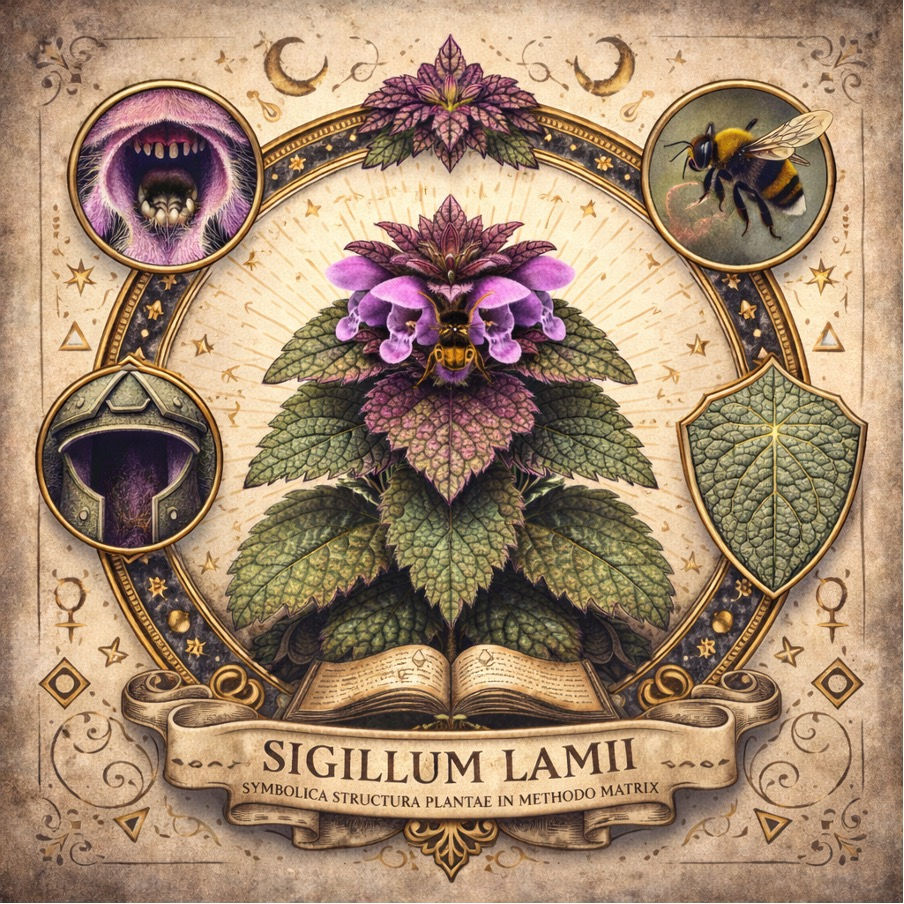
Seal of Lamium
Symbolic signature of the plant in the Matrix Method

Sigillum LamiiThe symbolic structure of the plant Lamium purpureum in Matrix methodology:mouth (attack), helmet (protection), bee (magnetism), leaf-shield (defense).
Themes of the remedy
1. The theme of clarity of expression and speech
One of the characteristic themes of Lamium is clarity of expression and ease in speech. These individuals often speak fluently, confidently, and without hesitation. They feel a need to express their opinion, and they do so directly and clearly, without excessive softening.
In clinical practice, it has been observed that they are often very talkative and capable of shaping their thoughts into clear and understandable speech. Words come easily, and communication represents for them a natural way of acting in the world.
One Lamium patient was a professor of English. Her lectures were contemporary, dynamic, and in tune with new pedagogical and technological trends. In her teaching, she used modern working methods and digital tools, thereby showing an ability to convey knowledge clearly and to maintain the attention of her students.
Another Lamium patient is politically active and expresses her views publicly. She speaks openly about social issues and participates in public discussions without hesitation. Her need to express her opinion clearly and to speak out publicly on important matters is another example of the pronounced communicativeness often encountered in this remedy.
In Lamium, speech is not only a means of communication, but also a way of occupying space in the world. Clear expression becomes part of their natural strength and directness.
2. The theme of directness — no filter
In Lamium, a marked directness in speech is clearly observed. These individuals speak openly and without restraint, often expressing their opinion without trying to soften it or adapt it to the listener.
Their speech is immediate and penetrating. When they think something — they say it. For this reason, they may sometimes appear harsh or overly direct, but behind this manner of expression there usually lies no bad intention, only a natural need for honesty and clarity.
As one Lamium patient said:“I say it as it is. If someone gets offended — that is their problem.”
Another patient described it this way:“I have no filter. I say everything to people’s faces.”
This trait becomes especially pronounced in situations where they feel it is necessary to react or to defend their position. Then the speech becomes even more decisive and forceful, in accordance with the fundamental Code of this remedy: ATTACK – DEFENSE.
Lamium does not like hidden messages or ambiguous situations. Words are spoken directly, without hesitation — as a natural expression of inner strength and readiness to take a clear stand.
3. The theme of protecting territory and one’s own people
In Lamium, the protective instinct is very strongly expressed. These individuals feel a powerful need to protect what they consider their own space, family, or close people. When they perceive that one of their own is threatened, the reaction can be very quick and intense.
Protection does not refer only to physical space, but also to the emotional and family circle. Lamium often has a pronounced sense of responsibility toward loved ones, especially toward children. In such situations, the readiness to react can be almost instinctive.
One patient described it very directly:“I would be capable of killing if someone touched my child.”
This sentence does not speak of an actual intention, but of the intensity of the protective impulse. When someone whom Lamium considers its own is threatened, the boundary between defense and attack becomes very thin.
In such situations, the fundamental polarity of this remedy becomes clearly visible. The protection of what is close can in an instant turn into a powerful response to threat. Thus, the Code ATTACK – DEFENSE manifests not only in the personal experience of danger, but also in the strong need to protect one’s own people and space.
4. The theme of rebellion and social struggle
In Lamium, one often notices a marked sense of social justice and a need to react when injustice or threat to the wider community is perceived. These individuals follow social and political events and often have clearly formed views about what is happening in society.
Unlike many other personality types who keep their dissatisfaction at the level of private opinion, Lamium has a need to express its position publicly. It does not hesitate to speak openly, even when it knows that such expression may provoke conflict or disagreement with the surroundings.
One Lamium patient actively participates in political life and publicly expresses her views on social issues. She regularly follows political events and takes part in protests and demonstrations, believing that it is important to react when she judges that something is wrong or unjust.
In such situations, one clearly sees how the fundamental Code of this remedy expands from the personal into the social sphere. The need to react, oppose, and protect what the person considers important goes beyond the boundaries of private life and becomes a form of social engagement.
Thus, the polarity ATTACK – DEFENSE manifests not only in personal relationships, but also in relation to society and the community. When Lamium judges that values it considers important are under threat, the reaction may be decisive, loud, and public.
5. The theme of fertility and reproductive potential
In Lamium, one often notices a strong vital energy that also manifests through marked physical strength and reproductive potential. These individuals usually appear strong, have good endurance, and possess great life energy.
In women, pronounced fertility is often observed. The organism shows a strong reproductive potential, as though the body has a natural capacity to create and sustain new life easily. This vitality is part of the broader biological strength that characterizes the Lamium structure.
In some cases, precisely this high fertility leads to a woman becoming pregnant multiple times, even in very unfavorable or almost impossible life situations. Consequently, her case history may also include numerous interrupted pregnancies, as a result of circumstances in which the pregnancy could not be accepted or carried through.
However, despite this natural fertility, Lamium women sometimes consciously decide that they do not want children in a relationship they perceive as unstable or without future. For them, the decision about motherhood is often not only emotional, but also includes a strong instinct for assessing safety and the future.
In this way, a strong biological capacity for reproduction may be accompanied by a very clear personal decision about when and with whom that possibility will be realized.
This combination of strong vitality, physical energy, and instinctive assessment of safety once again points to the fundamental polarity of this remedy — ATTACK – DEFENSE, which may also be reflected in the way Lamium approaches partnership, family, and offspring.
6. The theme of partner choice – between safety and kindred nature
In Lamium, an interesting dynamic is often observed in the choice of partner. At first, these individuals may be attracted to partners who represent stability, authority, and social status. These are often highly educated men — doctors, lawyers, or other people who inspire a sense of security and structure.
Such a choice partly corresponds to their need for protection and stability. A partner with a clear social position may represent a symbol of safety and support.
However, over time it often becomes evident that there is a deep gap between their raw, impulsive, and emotionally direct nature and the more rational, controlled nature of such partners. Lamium carries a strong, almost instinctive life energy that can hardly remain for long within the framework of an overly controlled relationship.
For this reason, it is not uncommon that later in life Lamium finds a partner who is closer to her own nature — a person who is strong, direct, and authentically alive. With such a partner, the relationship may be more intense and dynamic, but also more natural to her inner structure.
In this way, the life path of Lamium often shows an interesting pattern: an initial choice guided by the need for safety, and a final partnership with a person who shares a similar energy and way of experiencing the world.
7. The theme of mysticism, dreams, and unusual encounters
Besides a strong, direct, and combative nature, in Lamium one may often notice another, subtler layer of personality. These individuals sometimes show a marked sensitivity to dreams, intuition, and unusual life situations that they experience as meaningful or symbolic.
Patients often speak of vivid dreams, strong inner impressions, or unusual encounters that leave a deep mark in their memory. Sometimes they feel that they intuitively sense people and situations, as though they can foresee what will happen or what the true nature of a person may be.
This sensitivity does not dominate their personality, but it gives a special dimension to their inner world. Behind the outer strength and directness, there is a layer of intuitive perception and emotional depth.
In this way, one may recognize in the Lamium structure an interesting combination: strong vital energy and a combative nature on the one hand, and an occasional intuitive openness to subtler dimensions of experience on the other.
This layer of personality further confirms the complexity of the Lamium structure, in which strength, emotion, and intuition are interwoven.
8. The theme of raw physical strength and bodily constitution
In Lamium, one often notices a strong, almost raw physical vitality. The body appears firm, stable, and full of energy, leaving the impression of natural strength and endurance.
These individuals often have a strong constitution and good physical stamina. Their presence may seem energetic and dominant, as though the body carries a great quantity of vital force. Their movements are often decisive and confident, and the overall bodily structure gives an impression of strength and readiness for action.
This physical vitality fits into the general dynamic of Lamium. The raw energy of the body accompanies the inner readiness to react, which can once again be connected with the fundamental Code of this remedy — ATTACK – DEFENSE.
In this way, bodily constitution becomes yet another visible expression of the inner structure of the personality.
9. The theme of order, work, and meticulousness
In Lamium, one often notices a marked need for order and for the functional organization of everyday life. These individuals like to work, have good working energy, and are capable of carrying tasks through to completion.
They are often meticulous and pay attention to the tidiness of the space in which they live. The house and the immediate surroundings need to be orderly and pleasant, because such an environment gives them a sense of stability and satisfaction.
One Lamium patient described this simply in the words:“I like everything to smell pleasant when I enter the house.”
This need for tidiness and a pleasant atmosphere shows yet another aspect of the Lamium structure. Behind the strong and at times combative exterior lies a desire for a warm, harmonious, and well-organized space in which the person can feel safe.
In clinical practice, one often notices strong working energy and persistence in everyday duties. One Lamium patient, who lives in my immediate neighborhood, shows this quality very clearly. Every morning, without exception — whether it is raining, snowing, or sunny — she goes outside to clean the window ledges in detail, doing so quickly, energetically, and very thoroughly. After that, she continues by cleaning the sidewalk in front of the house. This routine is repeated daily with the same dedication and working energy.
Her daughter, who also corresponds to the Lamium structure, shows a similar capacity for work. She is very hardworking and actively manages the family business, keeping all business activities under control. Interestingly, even during the period when she was suffering from a severe illness considered incurable, she continued to work and to manage the affairs of the company.
Such working endurance and dedication to tasks once again point to the strong vital energy and persistence that are often encountered in Lamium.
10. The theme of unusual beauty — the union of Venus and the Moon
In Lamium, one often notices an unusual, striking beauty that immediately attracts attention. It is not always a classical, perfectly harmonious beauty, but something stronger and more magnetic — a union of sensuality, strength, and vitality.
The person seems to radiate energy when she appears in a space. People often notice her immediately. In her bearing and way of moving, one can see a strong Venusian influence — attractiveness, sensuality, and pronounced bodily energy.
At the same time, there is also a lunar softness in her expression. Behind the strong exterior lies an emotional and sensitive nature that experiences relationships and closeness deeply.
It is precisely this union that gives rise to a special kind of beauty:the strength of Venus that draws the eye, and the softness of the Moon that reveals the warmth of the soul.
For this reason, Lamium individuals often leave a strong impression — they appear at once powerful and gentle, as though they carry within themselves both light and raw life energy.
11. The theme of sudden reaction — the transition from calm to attack
In Lamium, one often notices the capacity for a sudden transition from a calm state into a strong, almost explosive reaction. As long as the situation is stable, the person may appear open, warm, and even very gentle. However, if she senses a threat — whether toward herself or toward someone she considers “her own” — the reaction may be exceptionally quick and powerful.
This change occurs almost instantly. It is as though, in a single moment, an inner mechanism of defense is activated, placing the person in a state of complete readiness to react. Then speech becomes even more direct, the gaze sharper, and the posture tense and directed toward the other person.
Such a reaction is not the result of cold calculation, but of an instinctive need for protection. Lamium reacts strongly when it judges that a boundary has been crossed or that someone belonging to its circle is under threat.
At that moment, the fundamental dynamic of this remedy becomes clearly visible — the Code ATTACK – DEFENSE. Attack is not an aim in itself, but a response to a sense of threat and to the need to protect space, family, or personal integrity.
12. The theme of inner warmth and a good soul
Despite the strong outer appearance and readiness for struggle, in Lamium one often discovers a very warm and well-intentioned nature. Behind the directness and at times sharp reactions, there is a person who feels deeply and sincerely wishes good to others.
Lamium individuals can be very generous and ready to help when someone falls into trouble. Their help is not only in words — it is often concrete, quick, and decisive. When they feel that someone needs support, they will react without much hesitation.
This warmth comes from an open heart and a strong emotional nature. Although they may appear combative and at times even intimidating, those who come to know them better discover that their inner nature is in fact soft, loyal, and deeply humane.
It is precisely this combination — strength that protects and a heart that feels — that forms the special inner structure of Lamium. Behind the energy of attack and defense lies the desire to preserve what is important: the people she loves, the space to which she belongs, and the values in which she believes.
13. The theme of adventure and the need for experience
In Lamium, one often notices a marked need for a life full of experiences. These individuals have a strong inner energy that drives them toward new situations, encounters, and challenges.
From early youth, they may show a tendency toward adventure. As children, they are often very brave, curious, and ready to carry out their ideas without much fear. In puberty, this energy may express itself through various adventures, exploration of the world, and intense emotional experiences.
Lamium does not like a passive life. She needs movement, dynamism, and the feeling that life is truly being lived. For this reason, she is often drawn to strong, adventurous people or enters situations that bring intense experiences.
This need for experience is part of their strong life energy. It carries risk, but at the same time gives a sense of aliveness, freedom, and authenticity that is very important for Lamium.
14. The theme of justice and the struggle for what is felt to be right
In Lamium, one often notices a strong sense of justice. These individuals distinguish very clearly between what they consider right and what they experience as injustice. When they feel that a boundary has been crossed or that someone has been unfairly threatened, they have a strong need to react.
Lamium does not remain on the sidelines when she sees injustice. On the contrary, she will often openly oppose it, even at the cost of personal discomfort or conflict. Her reaction is not always calculated — it often comes from a strong inner sense that something must be done.
For this reason, Lamium individuals often become actively involved in social events. They follow politics, participate in public discussions, and do not hesitate to express their opinion clearly. When they believe that something is wrong, they speak directly and without restraint.
One Lamium patient actively supported student protests. During the unrest, she brought food to the students and publicly expressed support for their demands, believing that it was important to stand with those whom she felt were fighting for justice.
This need to react to injustice once again shows the fundamental dynamic of this remedy. When threat appears — whether personal or social — the mechanism of ATTACK – DEFENSE is activated as a way of protecting the values in which the person believes.
15. The theme of hidden fear and inner vulnerability
Although Lamium outwardly appears strong, brave, and ready for battle, in the inner experience there may also be various fears. These fears are often not immediately visible to others, because the person rarely shows them openly.
In clinical practice, different forms of fear have been observed: fear of flying, fear of driving after a car accident, as well as fear related to health and the possibility of illness. These fears may be very real and intense, even though outwardly the person appears self-confident and stable.
What is characteristic is that Lamium often manages, despite these fears, to continue with everyday activities. The strength of personality and the will to act often prevail over the feeling of insecurity.
Thus, in the Lamium structure, an interesting contrast appears: outward courage and readiness to react, alongside an inner sensitivity that from time to time creates a feeling of fear or insecurity.
In some Lamium individuals, beneath the outer strength and combative manner, there may also exist a hidden sense of personal hurt or diminished worth. Although they outwardly appear strong and dominant, in certain situations they may experience a feeling of humiliation or inner injury.
In clinical practice, a tendency toward frequent urinary tract infections has also been observed, especially infections caused by the bacterium Escherichia coli. This bodily symptom sometimes appears in the context of emotional states in which the person experiences a sense of personal hurt, wounded dignity, or inner insecurity.
This contrast between outer strength and inner sensitivity once again shows the complex structure of Lamium — where strong reaction and combativeness often stand as a protection for a deeper vulnerability.
In some cases, a characteristic pattern is also observed in partner relationships. In youth, Lamium individuals may choose partners who possess strong authority or social status. Such a choice is often connected with the need for safety and stability. However, in these relationships there sometimes develops a dynamic in which Lamium gradually feels underestimated or humiliated. This pattern may intensify the inner feeling of personal hurt or diminished worth, even though the outer image remains strong and self-confident.
In this sense, the combativeness of the Lamium person is often not only an expression of strength, but also a way of protecting inner value. When feeling humiliated or diminished, the reaction may be strong and direct — as an attempt to restore injured dignity. It is precisely in this dynamic that the polarity of the Code ATTACK – DEFENSE is clearly recognized.
16. The theme of caring for one’s own people
In Lamium, one often notices a strong concern for the people it considers its own. Family, children, partner, or close friends occupy a very important place in her life. When their safety and well-being are concerned, Lamium may react very strongly and protectively.
This concern is not only emotional, but also very concrete. Lamium follows what is happening with the people she loves, thinks about their problems, and often takes an active role in resolving situations she experiences as dangerous or unjust.
Protective energy is especially pronounced toward children. In such situations, the reactions may be very strong, because Lamium feels a deep responsibility to protect what it considers its own.
It is precisely this care that often stands in the background of many Lamium reactions. When she senses that someone from her circle is threatened, the fundamental dynamic of this remedy is naturally activated — ATTACK – DEFENSE. Attack then is not an expression of aggression, but a strong instinct of protection.
17. The theme of material security and status
In Lamium, one may often notice a marked need for material stability and security. Financial security, success in work, and visible results of achievement may have great importance for these individuals, because they create a sense of a stable framework for life.
These individuals often pay attention to the outward impression they leave. Their way of dressing, the appearance of the home, as well as their standard of living may all be part of their need to maintain a certain level of security and social status.
However, material security in Lamium is not necessarily connected with passive enjoyment of acquired wealth. On the contrary, even when financial stability exists, there often remains a strong work energy and a need to work, create, and maintain what has been achieved.
In this way, material stability becomes yet another form of security that supports their fundamental life dynamic — the protection of space, family, and life values.
18. The theme of strong life energy
In Lamium, one often senses a strong life energy that permeates the whole personality. This energy can be seen in the way the person moves, speaks, works, and also in the way she enters into different life situations.
Lamium does not act passively. There is a constant inner driving force that directs her toward action, experience, and reaction. This energy may express itself through work, through social engagement, through emotional relationships, or through readiness to respond when she feels that something is under threat.
In the body, this vitality is often visible through a strong constitution and endurance, while on the psychological level it manifests as courage, determination, and readiness to live life intensely.
This strong life force lies at the foundation of many Lamium traits — directness, combativeness, the need for justice, protection of one’s own people, but also the tendency toward adventure. It gives dynamic power and strength to the whole personality structure.
In this sense, Lamium represents a type of person in whom the energy of life is expressed strongly and directly, often without restraint, yet with a clear inner need to protect what is considered important.
19. The theme of ordered space and aesthetic control
In some Lamium individuals, one also notices a marked orientation toward an ordered space and the outward impression they leave. A tidy home, cleanliness, and the aesthetic appearance of the surroundings are of great importance to them. Material security and visible results of work often form part of their sense of stability.
One Lamium patient, in addition to the house in which she lives, also has a house in the countryside, which she arranges with the same care and dedication. There too, everything is maintained down to the last detail — the space is orderly, clean, and carefully organized.
Lamium individuals often love flowers and plants, but here too there is a need for order and control. Plants are not left to grow freely wherever they wish; rather, everything is arranged, ordered, and kept in perfect form. Even in this detail, one can see their need to hold the natural energy of life within a clearly organized space.
Here we find:
• love of beauty (Venus)
• work and care for space
• the need for control and order
20. The theme of strong personal presence
Lamium individuals often have a strong personal presence that is felt as soon as they enter a room. Their energy, way of moving, and speech attract attention and create an impression of strength and confidence.
This presence does not arise only from outward appearance, but from a strong inner energy that can be felt in the way Lamium communicates, reacts, and takes her place in space.
For this reason, Lamium individuals often leave a strong impression on their surroundings. Their presence may seem at once attractive, strong, and somewhat intimidating, because behind it one senses a great amount of life energy and readiness to react.
In this way, Lamium does not occupy space quietly — it fills it with its energy, presence, and clear attitude.
This theme gathers together:
• beauty
• strength
• directness
• attack–defense
• social engagement
• working energy
This forms a beautiful final psychological portrait of the remedy.
In the Lamium structure, strength, work, protection, and the need for order merge into a unique life dynamic through which the fundamental
Code of this remedy is clearly recognized: ATTACK – DEFENSE.
Signature structure of Lamium in Matrix methodology
Botanical structure | Symbolic meaning | Clinical manifestation |
Flower resembling an open mouth with teeth | Attack, directness | The person speaks openly, without hesitation, says everything directly to one’s face |
Upper lip of the flower (helmet) | Protection, fighting instinct | Readiness to defend oneself and one’s boundaries |
Hairs at the entrance of the flower | Guards, control of access | Caution in relationships, does not allow closeness to just anyone |
Lower lip of the flower (platform) | Attraction, magnetism | Draws the attention and interest of others |
Narrow throat of the flower | Selection | Only the “chosen” may enter the inner circle |
Bees and bumblebees | Venus, magnetism | Attractiveness, charisma |
Leaf as a shield | Defense | Need to protect oneself and one’s own people |
Crown at the top of the plant | Dominance, summit of energy | Leadership qualities, ability to guide |
Nettle mimicry | Outwardly sharp, inwardly softer | A sharp outer manner that conceals sensitivity |
Cutting weeds | Elimination | Tendency to remove obstacles radically |
Herbicides and poisons | Complete removal | No peace until the problem is fully resolved |
In Lamium, nature shapes a precise architecture of attack and defense, in which every morphological structure of the plant finds its parallel in the psychological and clinical picture.

Matrix diagram of the Code of Lamium.The morphological structure of the plant Lamium purpureum reflects the fundamental dynamic of the Code ATTACK — DEFENSE, linking botanical characteristics with symbolic meaning and clinical manifestation.
The work now presents four levels of one remedy:
• botany
• symbolism
• clinical picture
• Matrix structure
The principle of Lamium
Lamium attracts, but at the same time guards its boundaries;it allows approach,but retains control over entry.
To attract — yet defend. To open — yet control the entrance.
THIS IS NOT THE END OF PAPER!
JUST A FEW MORE PAGES IN THE PART TWO!
DON'T MISS OUT!


Comments